
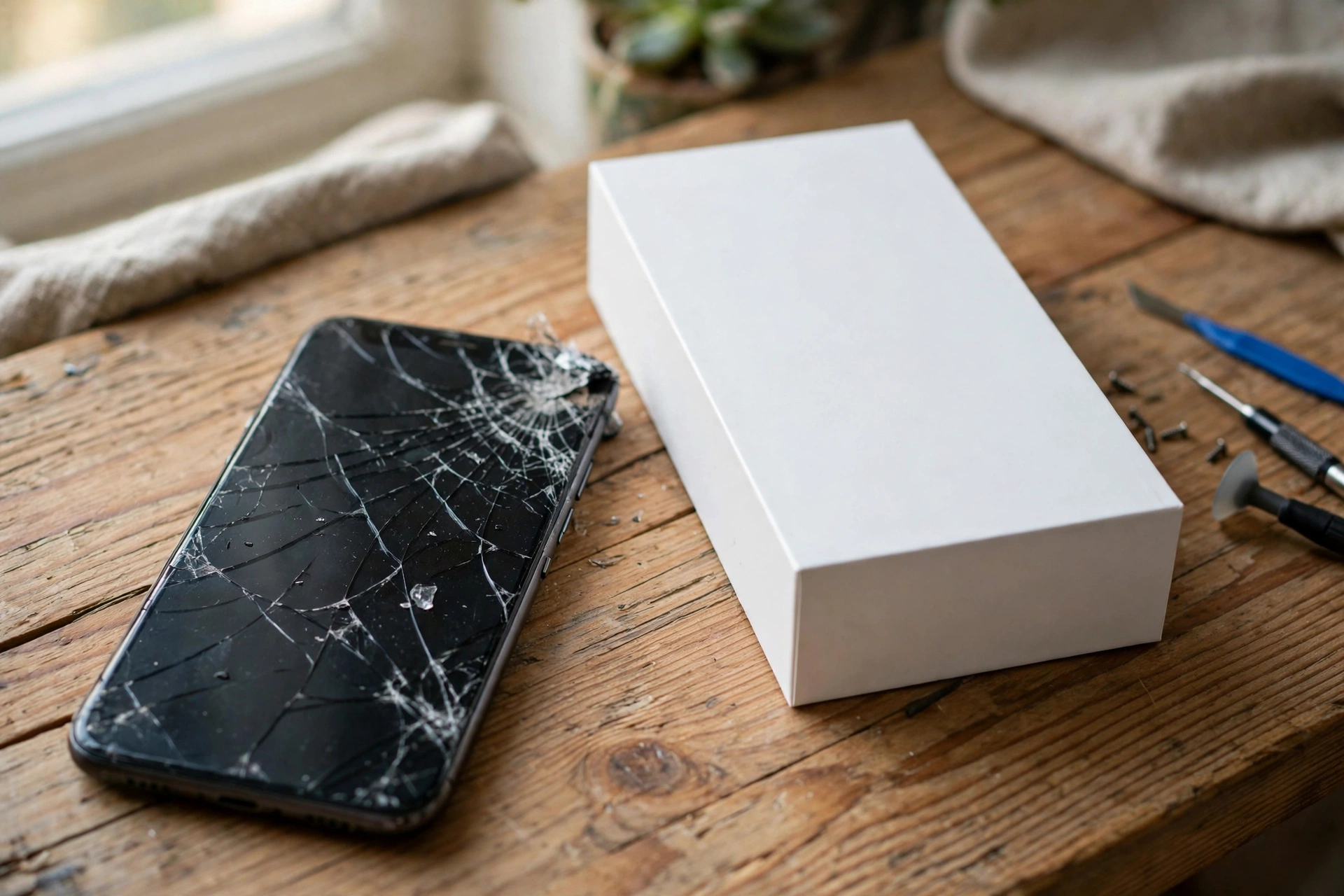
Every phone owner faces the same question eventually: is it worth fixing this phone, or time to replace it? There’s a simple rule that answers it for most people — the 50% rule. If the repair costs less than about half of what your phone is worth today, repair it. If it costs more, replace it. Here’s how to use it properly, and where it doesn’t apply.
How the 50% rule works
- Work out what your phone is worth today. Not what you paid for it — what it would sell for now, in its current condition. Check resale listings for your exact model and storage size.
- Get a written repair quote. The quote should list the part, the labour, and the warranty — with nothing added afterwards.
- Compare. Repair cost under ~50% of current value → repair. Over ~50% → think hard about replacing.
An example: your phone is worth $400 today and the screen repair is quoted at $150. That’s under 50% — repair it. If the same phone needs a $250 board repair, that’s over 50% — replacement starts to make sense.
When repair wins
- Only one thing is broken. A cracked screen or a tired battery is a straightforward fix — usually 30 to 60 minutes.
- Your phone still gets updates. If it still receives security updates, it has years of life left, and a repair protects that.
- Your data matters. Repair keeps your photos, apps, and settings exactly where they are. A new phone means hours of setup, transfer, and re-logging into everything.
- The repair is cheap relative to the phone. A $120 battery in a $500 phone is an easy yes.

When replacement wins
- The repair costs more than the phone is worth. Board damage, heavy water damage, or several faults at once can stack up past the phone’s value.
- Your phone no longer gets security updates. An unsupported phone is a security risk, no matter how well it runs.
- Multiple things are failing. Screen + battery + charging port together usually means the phone is at the end of its life — fixing one thing just reveals the next.
- You need features your phone can’t run. If your work or apps need a newer phone, no repair changes that.
What the rule misses
The 50% rule is about money, not everything. If your phone holds irreplaceable photos that aren’t backed up, repair is worth more than the math says — get the data safe first. And if you love your phone and it does everything you need, a repair slightly over 50% can still be the right call. The rule is a guide, not a law.
What a proper quote should include
Before you decide either way, get a free quote that lists three things:
- The part — exactly which part, and which quality grade.
- The labour — the full repair cost, not a per-hour surprise.
- The warranty — what’s covered, and for how long.
If a shop won’t put the quote in writing before starting, that’s a warning sign.

FAQ
Does the 50% rule work for tablets and laptops too?
Yes — the same logic applies. If the fix is under half the device’s current value and it still does the job, repair it.
My phone is old but works fine except the battery. Repair or replace?
Repair. A battery swap is one of the cheapest repairs there is, and it can give an older phone another year or two of life.
What if I can’t work out my phone’s current value?
Check resale listings for your exact model and storage. A repair shop can also give you a realistic figure when you get your quote.
Is a cheap replacement phone a better deal than a repair?
Not always. A used phone can hide a worn battery, a low-quality screen, or water damage. Always test battery health, Face ID, and cameras before buying used — or get your own phone repaired and keep the device you know.
Get your free quote
Call (936) 355-4068 or book online at Cell Geeks Huntsville for a free quote on your exact phone model — part, labour, and warranty listed up front, with nothing added afterwards. Then run the 50% rule on real numbers and decide with confidence.
Want the numbers for your exact phone first? Read Phone Screen Repair in Huntsville: Cost and Time, Honestly Explained — it breaks down what a screen repair really costs and how long it takes, so you can run the 50% rule on real figures.